





Pelvic floor health is an important but often overlooked part of overall wellness. Many people silently experience symptoms such as urinary leakage, pelvic floor weakness, reduced sexual satisfaction, or difficulty recovering core strength after pregnancy or menopause. The good news is that these issues are extremely common – and highly treatable.
Two of the most effective treatment approaches available today are traditional pelvic floor physiotherapy and Emsella pelvic floor therapy. While both are designed to strengthen the pelvic floor muscles and improve bladder control, they work in very different ways and may be suited to different individuals depending on their symptoms, comfort level, and lifestyle.
At Body Measure, we believe that informed patients make the best health decisions. In this article, we will explain how both treatments work, how they compare, and how to determine which option may be right for you.
Table Of Contents
- What Is Traditional Pelvic Floor Physiotherapy?
- What Is Emsella Pelvic Floor Treatment?
- How Do They Compare?
- When Traditional Physiotherapy Is The Better Choice
- When Emsella Is The Better Choice
- Frequently Asked Questions
- Which Treatment Is Right For You? Book A Consultation
What Is Traditional Pelvic Floor Physiotherapy?
Traditional pelvic floor physiotherapy is a specialized form of physical therapy that focuses on strengthening and coordinating the muscles that support the bladder, uterus, and bowel.
The pelvic floor is a group of muscles that act like a supportive hammock across the base of the pelvis. These muscles play a crucial role in bladder control, bowel control, sexual function, and core stability. When they become weakened or dysfunctional – due to pregnancy, childbirth, aging, menopause, surgery, or chronic strain – symptoms such as urinary leakage, pelvic pressure, or reduced pelvic support may occur.
A pelvic floor physiotherapist is trained to assess the strength, coordination, and control of these muscles. The assessment often includes a detailed medical history, discussion of symptoms, and a physical examination that may involve both external and internal evaluation.
Based on the findings, the physiotherapist develops a personalized rehabilitation program. Traditional therapy may include:
- Pelvic floor strengthening exercises (commonly called Kegels)
- Core and breathing coordination training
- Biofeedback techniques to improve muscle awareness
- Manual therapy to release tension or improve muscle activation
- Lifestyle and bladder training strategies
Patients are typically given exercises to perform at home between appointments. Consistency is essential, and improvement generally occurs gradually over several weeks to several months.
Research supports the effectiveness of pelvic floor physiotherapy for treating urinary incontinence. Studies have shown that supervised pelvic floor muscle training can significantly improve symptoms of stress incontinence, with many patients experiencing meaningful improvements in bladder control and quality of life.
Because this physical therapy focuses on education and active muscle retraining, it can also help patients develop lifelong strategies for maintaining pelvic health.
What Is Emsella Pelvic Floor Treatment?
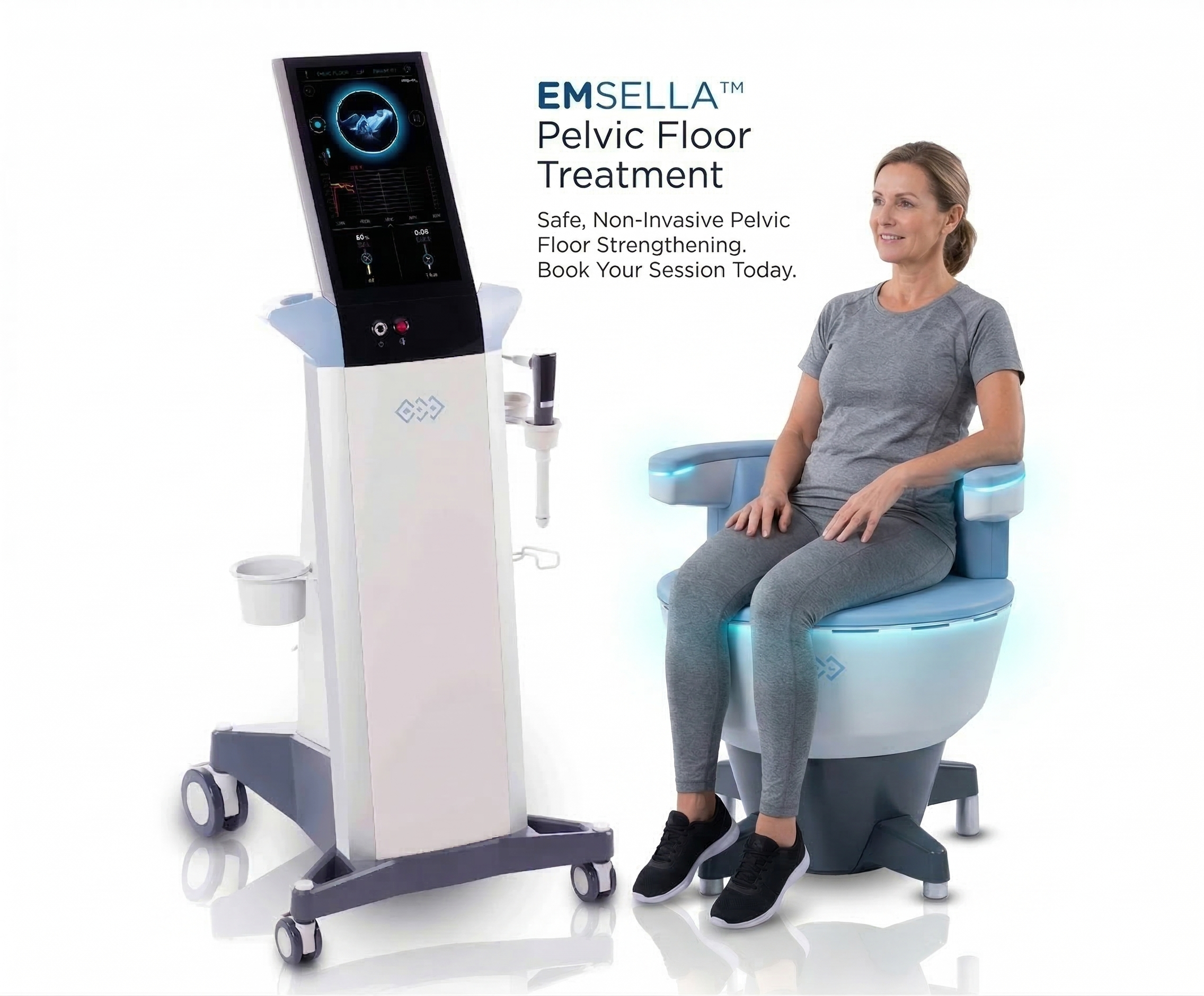
Emsella is a non-invasive medical treatment that strengthens the pelvic floor using high-intensity focused electromagnetic (HIFEM) technology.
Unlike traditional physiotherapy, which relies on voluntary muscle contractions, Emsella stimulates the pelvic floor muscles automatically using electromagnetic energy. This technology causes the muscles to contract thousands of times during a single treatment session – far more contractions than a person could perform voluntarily.
During treatment, patients sit comfortably on the Emsella chair while fully clothed. The electromagnetic field penetrates the pelvic floor tissues and stimulates deep muscle contractions that strengthen the entire pelvic floor.
Each session lasts approximately 28 minutes and is painless. Patients often describe the sensation as rhythmic muscle tightening or tingling.
A typical treatment protocol includes:
- Six sessions
- Two treatments per week
- Completed over approximately three weeks
Each session delivers the equivalent of roughly 11,000 supramaximal pelvic floor contractions.
Clinical studies have demonstrated significant improvements in urinary incontinence symptoms following Emsella therapy. Research published in the Journal of Women’s Health and Urology has reported improvements in quality of life scores, reductions in incontinence episodes, and measurable increases in pelvic floor strength following treatment.
Because Emsella works automatically, it can be particularly beneficial for individuals who have difficulty activating their pelvic floor muscles correctly during exercises.
How Do They Compare?
Both pelvic floor physiotherapy and Emsella therapy are effective treatments for pelvic floor weakness and urinary incontinence. However, they differ significantly in how they work, the experience for the patient, and the time commitment involved.
Before reviewing the comparison, it is helpful to understand the clinical outcomes associated with Emsella treatment. Multiple clinical studies have demonstrated meaningful improvements in bladder control, symptom severity, and overall quality of life for individuals undergoing treatment.
Summary Of Clinical Outcomes With Emsella:
| Metric | Typical Clinical Result |
| Incontinence Improvement | 50%-60% reduction in symptoms |
| Complete Continence | ~21%-31% of patients reach “zero” leakage |
| Patient Satisfaction | ~95% report improved quality of life |
| Pad Reduction | Average decrease of 1.5-2 pads per day |
These results reflect findings reported in published studies evaluating high-intensity focused electromagnetic (HIFEM) therapy for pelvic floor strengthening. While individual outcomes vary, the research consistently demonstrates significant improvement in urinary incontinence symptoms and patient quality of life following treatment.
Below is a comparison of how Emsella therapy and traditional pelvic floor physiotherapy differ in their approach, treatment experience, and time commitment:
| Category | Traditional Pelvic Floor Physiotherapy | Emsella Treatment |
| Treatment Approach | Manual exercises, muscle retraining, and physiotherapist-guided rehabilitation | High-intensity focused electromagnetic stimulation causes thousands of automatic contractions |
| Session Experience | Often includes internal examination and guided exercises, plus homework between sessions | Sit comfortably in a specialized chair, fully clothed |
| Time Commitment | Typically requires weekly sessions and home exercises for weeks or months | Six sessions completed over three weeks |
| Effectiveness | Strong evidence supports pelvic floor muscle training as first-line therapy for urinary incontinence | Clinical studies show significant improvements in bladder control and pelvic floor strength |
| Cost & Insurance Coverage | Often covered by extended health insurance plans | May be eligible through Health Spending Accounts (HSAs), depending on plan |
When Traditional Physiotherapy Is The Better Choice
Traditional pelvic floor physiotherapy remains an excellent treatment option for many individuals, particularly when a comprehensive rehabilitation approach is required.
Physiotherapy may be the better choice if:
- You have complex pelvic floor dysfunction:
Conditions such as pelvic pain, muscle tension disorders, or pelvic organ prolapse often require hands-on assessment and individualized rehabilitation strategies. - You want a highly personalized rehabilitation program:
A physiotherapist can evaluate your movement patterns, posture, breathing mechanics, and muscle coordination to design a treatment plan tailored specifically to your body. - You are recovering from childbirth or pelvic surgery:
Postpartum recovery often benefits from guided physiotherapy to safely restore pelvic floor and core function. - You prefer a structured program with professional coaching:
Some individuals appreciate the ongoing support, education, and accountability that physiotherapy provides. - You want to build long-term pelvic floor awareness:
Physiotherapy helps patients understand how to activate and control their pelvic floor muscles effectively in everyday activities.
When Emsella Is The Better Choice
Emsella can be an excellent option for individuals who want a faster, non-invasive approach to strengthening the pelvic floor.
Emsella may be the better choice if:
- You experience stress urinary incontinence:
Many individuals leak urine when coughing, laughing, sneezing, or exercising due to pelvic floor weakness. Emsella is designed to strengthen these muscles efficiently. - You want a treatment that requires minimal time commitment:
Completing six sessions over three weeks can be far more convenient than months of physiotherapy appointments. - You have difficulty performing pelvic floor exercises correctly:
Many people struggle to properly activate the pelvic floor muscles. Emsella bypasses this issue by stimulating the muscles directly. - You prefer a non-invasive experience:
Emsella requires no internal examination and no physical exercises during the appointment. - You want to enhance results alongside other treatments:
Emsella can complement lifestyle changes, pelvic floor training, or postpartum recovery programs.
Frequently Asked Questions
Is Emsella as effective as pelvic floor physiotherapy?
Both treatments are clinically proven to improve pelvic floor strength and urinary incontinence. Physiotherapy is considered a foundational treatment because it teaches long-term muscle control, while Emsella offers rapid muscle strengthening through electromagnetic stimulation. In many cases, the best results come from combining both approaches.
Can I do both Emsella and physiotherapy at the same time?
Yes. Many individuals choose to combine Emsella with pelvic floor physiotherapy. Emsella strengthens the muscles rapidly, while physiotherapy teaches coordination, control, and long-term maintenance strategies. The combination can produce excellent results.
Which is better for postpartum incontinence?
Both treatments can be helpful after pregnancy and childbirth. Physiotherapy is often recommended first because it helps retrain the muscles and restore proper coordination. However, Emsella can also be very effective for strengthening the pelvic floor once healing has occurred.
How many sessions of each treatment do I need?
Pelvic floor physiotherapy often requires multiple sessions over several weeks or months, depending on the severity of symptoms. Emsella treatments are typically completed in six sessions over three weeks, though some patients may choose maintenance treatments afterward.
Is Emsella covered by insurance in Canada?
Coverage varies by insurance provider. While Emsella is not typically covered under traditional physiotherapy benefits, many individuals can use Health Spending Accounts (HSAs) or wellness benefits to cover the treatment. It is always best to check directly with your insurance provider.
Do I need a referral for either treatment?
In most cases, a referral is not required for pelvic floor physiotherapy or Emsella treatment. However, some insurance plans may require a physician referral for reimbursement.
Which Treatment Is Right For You? Book A Consultation
Choosing the right pelvic floor treatment depends on your symptoms, comfort level, and health goals.
Some individuals benefit most from the guided rehabilitation and education offered by pelvic floor physiotherapy. Others prefer the convenience and efficiency of our Emsella chair treatment in Winnipeg. Many people find that a combination of both approaches provides the strongest and most sustainable results.
At Body Measure, we believe pelvic health should never be ignored or dismissed. Our team can help you understand your options and determine the most appropriate treatment plan for your needs.
If you are experiencing urinary leakage, pelvic floor weakness, or postpartum recovery challenges, we encourage you to take the first step toward improving your pelvic health.
Book a consultation with our team to learn whether Emsella, pelvic floor physiotherapy, or a combination of both may be right for you.

Melina holds a Master of Science in Community Health, and has devoted most of her career to helping older adults live a healthy and vibrant lifestyle. In her role as research coordinator, she saw firsthand how important it was for her clients to know and understand their unique body composition. Melina is a certified obesity counsellor with The World Obesity Association. She has personally lost 100 pounds, and is passionate with helping others reach their healthy weight.